In the FOOD FOREST project, communities are at the heart of the initiative.
Communication and transparency are essential for building trust and bringing people together. FOOD FOREST seeks to give citizens and community stakeholders the knowledge, skills and confidence they need to participate actively in shaping the project’s future.
Through practical learning, shared decision-making and direct involvement in the care and development of the sites, the project aims to foster a genuine sense of ownership and stewardship. This active participation gives practical meaning to the concept of a community-managed food forest.
A wide range of events and activities invites citizens, community groups and organisations to engage with FOOD FOREST and become part of its day-to-day development. These include project presentations, information sessions, public lectures, educational activities, volunteering days and co-design workshops focused on learning, participation and collaboration.
In Italy and Portugal, where the food forests are planned for a later phase of the project, engagement has focused primarily on interviews and meetings. These conversations help identify key organisations and stakeholders while developing a clearer understanding of local needs, challenges and opportunities.
In Spain and Estonia, where the pilot food forests are already being developed, face-to-face activities have proved particularly effective in bringing the project closer to the communities it intends to serve.
Community engagement in Artajona has combined knowledge exchange, practical learning, volunteering and dialogue with different groups from the municipality and surrounding areas.
The project team visited the community of Artieda in Navarre to learn about its sociocratic governance model and facilitate the exchange of experience between communities. A visit to the Parque de los Sentidos de Noáin also provided an opportunity to explore an established environmental initiative and identify ideas that could be adapted or replicated in Artajona.
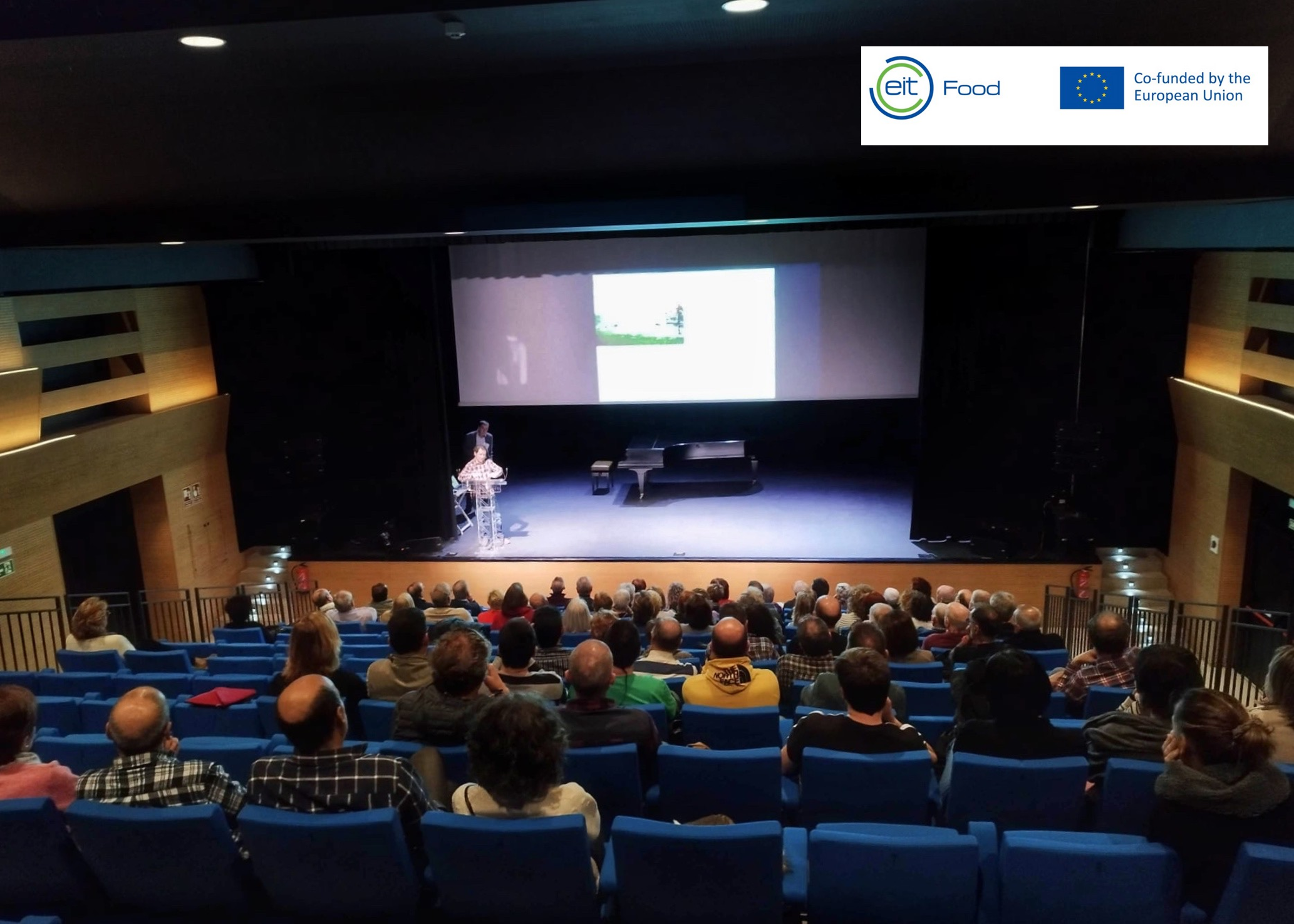
An explanatory session introduced the wider European FOOD FOREST project and presented the work already undertaken in Artajona since the initiative began.
Practical participation has been equally important. Volunteers contributed to soil sampling activities and took part in planting days during which more than 200 trees were planted in the Artajona Food Forest.
(INSERT PHOTO: 13-artajona-seedlings.jpg — Seedlings prepared for planting during a community volunteering activity.)
(INSERT PHOTO: 14-artajona-planting-2.jpg — Community participants working together at the Artajona pilot site.)
The project was also presented at the Artajona Seniors’ Centre, known locally as the Jubiloteca. Claudia Pennese from RB3 and Isabel Guevara Fernández from EHU spent the morning with members of the senior citizens’ club, sharing information about the initiative and involving older residents in its development.
(INSERT PHOTO: 03-artajona-project-presentation.png — FOOD FOREST presentation to members of the Artajona Seniors’ Centre.)
These activities connect the food forest with the wider life of the municipality and create opportunities for people of different ages and backgrounds to contribute their experience, knowledge and ideas.
In Tallinn, community participation has brought together urban gardening specialists, local residents, trainees and people interested in discovering food forests and edible plants.
During the Urban Gardening Experience Exchange Day, Maria Derlõš presented an overview of urban gardening in Tallinn. The session also introduced the FOOD FOREST project and was accompanied by a press release for the wider event.
The Tallinn Food Forest co-design event gave participants an opportunity to contribute directly to the development of the pilot, share ideas and explore how the site could respond to community needs.
(INSERT PHOTO: 02-tallinn-co-design.jpg — Participants contributing ideas during the Tallinn Food Forest co-design event.)
(INSERT PHOTO: 04-tallinn-community-event.jpg — Community members attending an outdoor FOOD FOREST activity in Tallinn.)
Public learning activities have addressed questions such as whether food grown in the city is safe and have introduced the research being conducted in Tallinn’s urban gardens. Participants in the Trainers Training programme also delivered introductory sessions on Community Food Forests for people who were unfamiliar with the concept.
A series of practical days helped prepare and establish the Community Food Forest. Participants worked together on the site, while a public event introduced the project’s progress and supported the creation of a new ecological guild within the food forest.
(INSERT PHOTO: 05-tallinn-practical-day-1.jpg — Participants preparing the Tallinn Community Food Forest.)
(INSERT PHOTO: 06-tallinn-practical-day-2.jpg — Practical community work during the establishment of the food forest.)
The programme has also included wild-plant trips and shared cooking activities delivered in both Estonian and Russian. These experiences connect ecological knowledge with food culture and provide an informal setting in which participants can learn from one another.
(INSERT PHOTO: 08-wild-plants-and-cooking.jpg — Exploring edible wild plants through shared learning and cooking.)
Additional public planting events have introduced new plants to the Community Food Forest while updating participants on the project’s development. Visits to food forests in Türi have extended this exchange of knowledge beyond the pilot site and allowed participants to learn from other practical examples.
(INSERT PHOTO: 09-wild-plant-trip-1.jpg — Participants exploring plants and food-forest practices in Tallinn and Türi.)
(INSERT PHOTO: 10-wild-plant-trip-2.jpg — Community learning and knowledge exchange during a food-forest visit.)
Together, these activities show how FOOD FOREST is developing through participation rather than around it. By creating opportunities to learn, contribute and make decisions collectively, the project is laying the foundations for food forests that communities can recognise, support and care for over the long term.

FOOD FOREST is a European initiative creating and testing Community Food Forests as living spaces for regenerative food production, ecological restoration, education and social innovation.Through pilot sites in Artajona and Tallinn, partners from across Europe work with local communities to develop knowledge and models that can be replicated and scaled.
Connecting Community Food Forests, projects and practitioners across Europe.
welcomes collaboration with institutions, researchers, practitioners, communities and organisations working on regenerative landscapes, food systems and community-led innovation.
Rotary Forests supports FOOD FOREST as a Strategic Benefactor, contributing economic, technical, creative and infrastructure resources to the project and its digital platform.