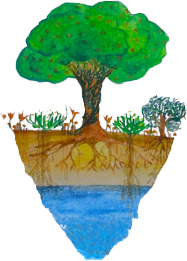
Category:Rewilding Through Co-Creation is a six-year Living Lab initiative established in Hungary in 2025. Operating across urban and rural settings in Budapest and Mencshely, in the Balaton Uplands, the project explores how communities can regenerate landscapes, strengthen ecological knowledge and develop more resilient relationships with food and nature.
Wild edible plants, biodiversity and locally rooted knowledge provide the foundation for a collaborative process in which participants learn, experiment and develop regenerative practices together. By connecting urban and rural environments, the initiative can explore how community-led ecological regeneration responds to different social, cultural and environmental conditions.
The project is coordinated by a core team of four staff members and currently involves approximately 20–30 participants. It follows a community self-management model based on shared responsibility, collective decision-making and continuous learning rather than a rigid or predetermined structure.
Rewilding Through Co-Creation understands rewilding not only as the recovery of natural processes, but also as the restoration of people’s capacity to understand, care for and collaborate with their local ecosystems. Its work brings together agroecology, permaculture, food sovereignty, biodiversity conservation and experiential education.
Participants explore wild edible plants, observe ecological processes and test regenerative practices through workshops, practical training, participatory planning and community-based research. Traditional, practical and scientific knowledge are combined through direct experience, allowing participants, facilitators and collaborating organisations to learn from one another.
The six-year Living Lab provides a long-term framework for experimentation, documentation and adaptation. Activities include biodiversity observation, landscape experimentation, co-design, ecological education and the exchange of knowledge between urban and rural participants. The project also reflects on climate resilience, local food sovereignty and the role communities can play in responding to environmental degradation.
Its self-management model places participants at the centre of the project’s development. The core team provides coordination, facilitation, research support and continuity, while community members contribute their knowledge, experience and practical work. This shared approach reinforces local ownership and allows the initiative to evolve through the relationships formed between people, place and ecological processes.
Expected outcomes include greater knowledge of wild edible plants and local biodiversity, stronger connections between communities and landscapes and increased capacity for collective environmental action. The project also seeks to develop practical regenerative skills, generate locally adapted responses to climate challenges and document methods that can inform other Community Food Forest initiatives.
As a member of the European Community Food Forest Network, Rewilding Through Co-Creation is interested in exchanging practical experience, participating in joint training and educational programmes and developing collaborative research, documentation and pilot activities.
The initiative can contribute its experience as a long-term Living Lab combining community self-management, ecological learning and regenerative experimentation across urban and rural environments. Its principal areas of interest include biodiversity, wild edible plants, agroecology, permaculture, food sovereignty and participatory approaches to landscape regeneration.
The project welcomes collaboration with Community Food Forests, educators, researchers, environmental practitioners, community organisations and European partners interested in shared learning and ecological regeneration.
Contact person: Adrienn Bátor
Email: batoradrienn@gmail.com
Country: Hungary

FOOD FOREST is a European initiative creating and testing Community Food Forests as living spaces for regenerative food production, ecological restoration, education and social innovation.Through pilot sites in Artajona and Tallinn, partners from across Europe work with local communities to develop knowledge and models that can be replicated and scaled.
Connecting Community Food Forests, projects and practitioners across Europe.
welcomes collaboration with institutions, researchers, practitioners, communities and organisations working on regenerative landscapes, food systems and community-led innovation.
Rotary Forests supports FOOD FOREST as a Strategic Benefactor, contributing economic, technical, creative and infrastructure resources to the project and its digital platform.